
Lot 5100
Sale 115 · Important Australian, Ancient British & World Coins, Medals & Banknotes
Images
Coin 1
Coin 2
Description
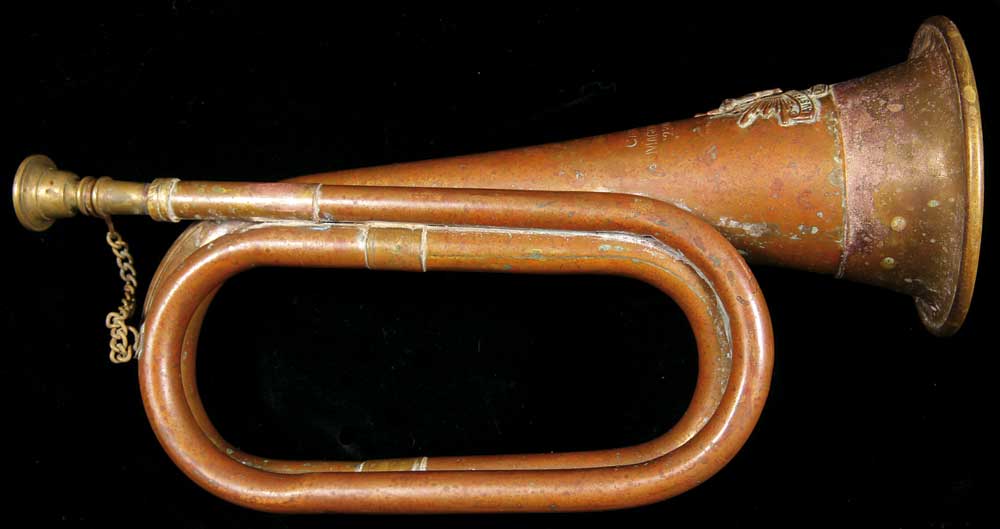
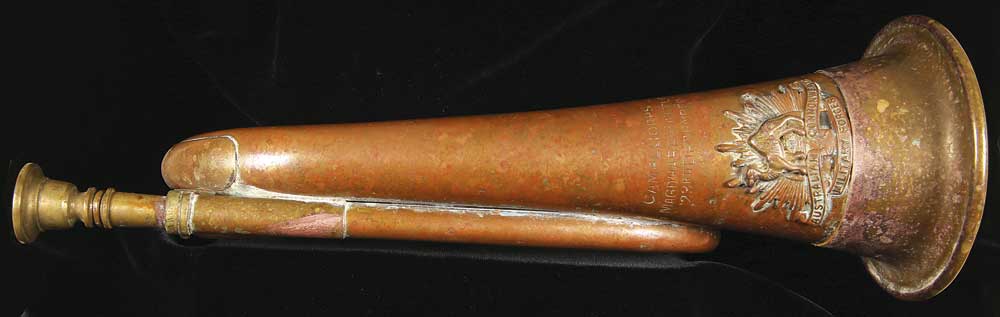
Camel Corps commemorative bugle, an M1855 British Duty bugle made of copper and brass with small safety chain from mouthpiece to body of bugle, and soldered at the side above the bell is a Rising Sun badge and affixed on the crown is a brass cut-out camel facing left, above the badge is inscribed, 'CAMEL CORPS/MAGDHABA BATTLE/23rd DECEMBER/1916'. One time cleaned with traces of cleaning compound in grooves, now retoned, with various oxidation spots, otherwise good very fine.
Together with a modern, storage case, zip opening with carry-handle and some colour photos of bugle, a bugler and battle details.
The Imperial Camel Corps was formed in January 1916 to deal with the revolt of pro-Turkish Senussi tribesmen in Egypt's Western Desert. It had four regiments, each of about 770 men, the first and third Australians with many recruited from men of Australian Infantry battalions who had fought in the Gallipoli Campaign, the third was British and the fourth a mix of New Zealanders and Australians and at full strength it employed nearly 4,000 camels.
Australia's part in the Battle of Magdhaba on 23 December 1916 came under the control of Major General Harry Chauvel whose force for the attack on Magdhaba consisted of three brigades of the Anzac Mounted Division; 1st Light Horse Brigade (1st, 2nd and 3rd Light Horse Regiments), the 3rd Light Horse Brigade (8th, 9th and 10th Light Horse Regiments), the New Zealand Mounted Rifles Brigade (Auckland, Canterbury and Wellington Mounted Rifles Regiments), together with three battalions from the Imperial Camel Brigade in place of the 2nd Light Horse Brigade. These nine regiments and three battalions were supported by the Inverness and Somerset Artillery Batteries, Royal Horse Artillery, and the Hong Kong and Singapore Artillery Battery.
The attack was planned by Chauvel as one of envelopment of the Turks and their supporters who were blocking the allied route to Palestine. The Flying Corps provided assistance by spotting Ottoman defences and movements. The attack started at 0630 and by 1200 all brigades were heavily involved in the action. By about 1700 all organised resistance ceased and as darkness fell, sporadic firing petered out, while prisoners were rounded up, horses collected and watered at the captured wells. Then Chauvel rode into Magdhaba and gave the order to clear the battlefield. In an address to the troops after the battle, Lieutenant General Sir Phillip Chetwode commander of the Desert Column expressed his appreciation for the mounted rifle and light horse method of attack. He said that in the history of warfare he had never known cavalry to not only locate and surround the opponent's position, but to dismount and fight as infantry with rifle and bayonet.
- Estimate
- $500
- Result Status
- Sold
- Prices Realised
- $1,800