
Lot 3259
Sale 97 · Important Australian & World Coins, Medals & Banknotes
Images
Description
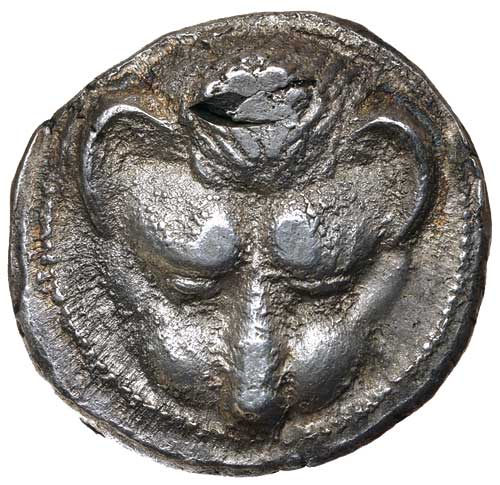
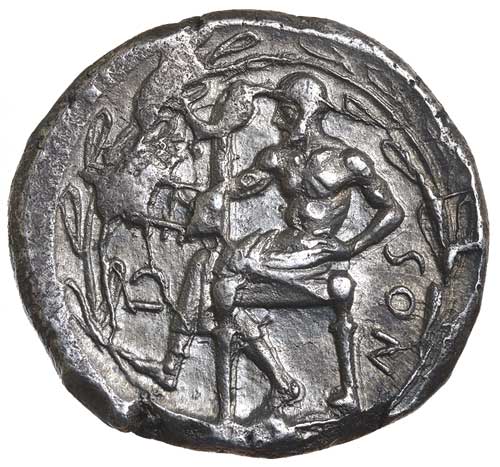
Italy, Bruttium, Rhegion, (c.450 B.C. [Arnold-Biucchi chronology]), silver tetradrachm, (17.26 grams), obv. lion's head facing, within dotted border, rev. Iokastos the traditional founder of the city naked to waist and seated to left, holding staff and resting left hand on hip, all within laurel wreath, legend around anti-clockwise, RECI NOS, (S.498 [£1250], Herzfelder, H., 'Catalogue des Tetradrachmes et Drachmes de Rhegion' 1, [obv.D1, rev.R1 same dies], [Revue Numismatique (RN) 1956], Randazzo, (Arnold Biucchi) 9 [This Coin, p.48 and illustrated Plate 1,9], SNG ANS 635). Some flatness on the high surface of the facing lion, also with an interesting die crack on the reverse, original obverse die somewhat rusted, otherwise good very fine, and very rare.
Ex Noble Numismatics Sale 73 (lot 3208) and Sale 59 (lot 1801) and previously from the Randazzo Hoard (no.9), see ANS Numismatic Studies 18 'The Randazzo Hoard 1980 and Sicilian Chronology in the Early Fifth Century B.C.' (see p.17-9, 48). Although ten tetradrachms of this city were present in the Randazzo Hoard, only four were of this type and all came from the first obverse and first reverse dies of this series. The reverse die shows a breaking up and a similar example with the same degree of die-breaking occurs on Plate XX No.1q in RN 1956. Herzfelder in his extensive study on this coinage knew of 19 examples of this coin from these dies of which 9 were from the same state of die deterioration as this example from the Randazzo Hoard (he lists the references of all the then known examples). Many of the examples known are in public collections. For all dies Herzfelder was only able to find 46 coins of this type. Together with the four from Randazzo only 50 surviving examples are known today. The seated figure on the reverse presents problems of interpretation, because in the course of the series his iconography varies; usually he is a bearded mature man, but sometimes a beardless youth. Six followed by Herzfelder, identified him as the heroised founder Iocastus, son of King Aeolus of the Lipari Islands, who died as a result of a snake bite and whose tomb became the site of the Chalcidian-Messenian colony of Rhegium.
- Estimate
- $3,000
- Result Status
- Sold
- Prices Realised
- $2,300