
Lot 2635
Sale 96 · Important Australian & World Coins, Tokens, Medals & Banknotes
Images
Description
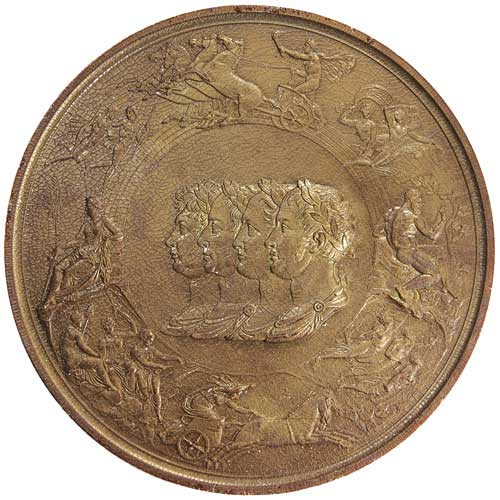
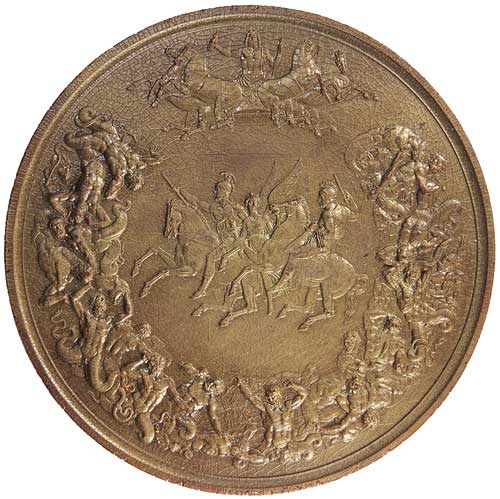
Battle of Waterloo, 1815, pair of uniface gutta-percha castings (135mm) from the original dies, by Benedetto Pistrucci, obverse, conjoined, laureate, draped busts of the four allied sovereigns, the Prince Regent, Francis II of Austria, Alexander I of Russia and Frederick William of Prussia, Apollo in a chariot above, figures of Justice and Hercules, Night in a biga below, with the Furies and the Fates, reverse, Victory guides the mounted figures of Wellington and Blucher, Jupiter in a quadriga above, and a complex border of nineteen entwined figures (for the nineteen years of the war) symbolizing the battle of the giants; with several pages of contemporary hand written descriptions, a small card signed H.W. Field (Queen's Assay Master, Royal Mint), in original black Japanned metal case (BHM 870). Very rare, light surface crazing, otherwise as originally cast.
Probably the most famous and impressive medal in the British series, existing only as electrotypes and gutta-percha castings. Gutta-percha is a natural product from the exudate of certain trees, chemically related to rubber. At the time of the production of these medals it was the only "plastic" type casting material available. In 1819 the Prince Regent gave the order to produce a medal of surpassing magnitude and beauty to commemorate the Battle of Waterloo. Pistrucci was given the task of producing the medals which were to be presented to the allied sovereigns and other dignitaries, including the two commanders, Wellington and Blucher. There followed a protracted series of disputes between Pistrucci and the authorities, mainly over payment for the work. The result was that the dies were not completed until 1849, thirty years after the original order, when, of the intended recipients, only Wellington remained alive. Because of the difficulty in hardening dies of the size required to strike the medal, each die was made in two parts, an outer ring and a central die. However the hardening was never carried out and only gutta-percha impressions and electrotypes were made. For a detailed description of the allegorical significance of the design and the extended production process see British Historical Medals Volume I, pages 208-212.
- Estimate
- $4,000
- Result Status
- Sold
- Prices Realised
- $3,800