
Lot 2688
Sale 88 · Important Australian & World Coins, Medals & Banknotes, Dr John Chapman Collection
Images
Description
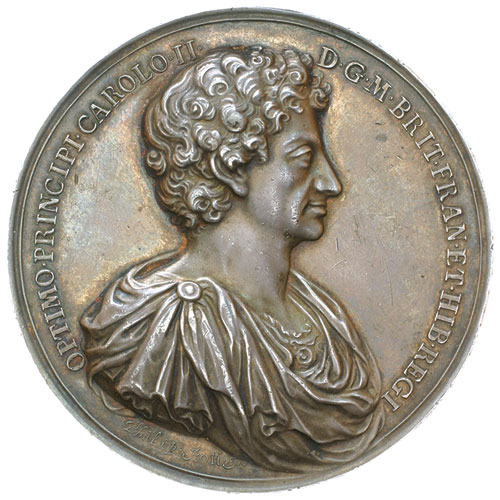
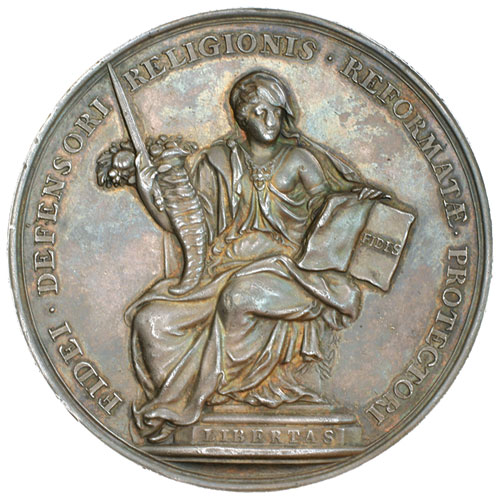
Charles II, (1660-1685), large silver medal. 1672. by Philip Roettiers. 59mm diameter. Known as the `Liberty of Conscience' medal. Dies in British Museum (legend in Latin "Defender of the Faith, Protector of the Reformed Obverse: Draped bust of King Charles II with short hair, facing right. Mantle fastened with small brooch on right shoulder. Legend: OPTIMO. PRINCIPI. CAROLO. II. D.G.M.BRIT.FRAN.ET.HIB.REGI. (`To the most excellent Prince, Charles II, by the Grace of God King of Great Britain, France and Ireland). Below is Roettier's signature. Reverse: Female figure sitting on a plinth with the inscription `LIBERTAS' holding a sword and cornucopia in one hand and a book inscribed FIDES in the other hand. The legend reads FIDEI. DEFENSORI. RELIGIONIS. REFORMATAE. PROTECTORI (Defender of the Faith, Protector of reformed religion'), (Eimer 249, MI i, 553-4/214). Toned, extremely fine or better, rare.
Although this remarkable medal is undated, it is assumed that it celebrates the King's Declaration of Liberty of Conscience, which was dated 15th March 1672. There had been a fear in England that continuing wars against the Dutch were simply an excuse for the King to reintroduce rule without Parliament and Catholicism. The Declaration of March 1672 suspended restrictions on Catholics and Protestant dissenters, but the effect was to confirm in the public's minds the association of arbitrary government, Catholicism and an unpopular foreign policy. As the war foundered, Parliament forced the King to withdraw the declaration and in its place they enacted the anti-Catholic Test Act in 1673 which banned Catholics from holding many positions of power. Although those who had signed his father's death warrant were punished (9 regicides were put to death) and Cromwell's body was exhumed from Westminster and put in a common plot, Charles II pursued a policy of political tolerance and power sharing. His attempts to promote greater religious tolerance were met with suspicion. He was however a charismatic pragmatist who successfully walked a tightrope during his 25 year reign and notably only became a Catholic on his deathbed in 1685. Medallic Illustrations of British History states: `This medal is very beautiful, though the figure on the reverse is somewhat clumsy and ungraceful.' But it should be noted that the features of the lady are never well struck up on this particular medal - probably because this area of the reverse design corresponds with the most raised area of the King's head on the obverse, but one could not hope to find a better preserved example of this rare, handsome and numismatically fascinating medal.
- Estimate
- $2,100
- Result Status
- Sold
- Prices Realised
- $2,000