
Lot 2804
Sale 80 · Important Australian, New Zealand & World Coins, Medals & Banknotes
Images
Description
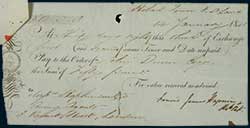
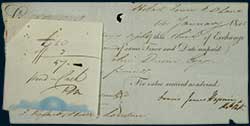
Military Bill of Exchange, Hobart Town, V.D Land 14 January 1845, third of exchange payable to John Dunn Esq for fifty pounds issued by Capt Francis James 11th Regt (?), addressed to Messrs Hopkinson & Co, Army Agents, 3 Regent Street, London with discount encashment note attached '£50 off 3/47 paid in cash PM'. (PM = pro manager) Vignette of ships on left border, imprint of Bock Hobart Town. Spike hole otherwise very fine.
Ex W.J.D. Mira Collection. Similar to lots 2772, 2774 (Sale 77), this is the only example we have seen on behalf of the military. John Dunn (1790-1861), merchant and banker, was born in Scotland, son of William Dunn, a weaver. At 16 he was apprenticed to a 'manufacturer of cotton and linen' and his articles were endorsed in 1811. Dunn set sail to Van Diemen's Land in 1821 aboard Hope with wife Catherine n‚e Colville and son John. En route the Hope was wrecked on the Goodwin Sands and the family was transferred to the Heroine, where they joined with Dunn's wealthy mother-in-law. Arriving at Hobart Town on 10 September 1822, the family was granted land on the South Esk River, which Dunn soon sold to set up a shop on the corner of Elizabeth and Bathurst Streets in Hobart. From these premises Dunn gained a reputation of minor notoriety by issuing 'small promissory notes on wretched paper which soon wore out, whereon he would refuse to honour them'. In 1823 Dunn entered banking as an original shareholder of the Bank of Van Diemen's Land and then in 1828 as a founding director of the Derwent Bank. He left the Derwent Bank and sold his interests in 1829 and opened the Commercial Bank in June 1829 on the site of Gellibrand's old Tasmanian Bank. In 1832 the bank became a joint stock company and hence Dunn ceased to be sole-proprietor, though he maintained his role of managing director until 1857. During his administration the bank was remarkably successful and resulted in Dunn becoming one of the wealthiest and most respected citizens of the colony. He died at Hobart on 20 January 1861 and was buried at St George's Church of England, Battery Point with the chief justice, Sir Valentine Fleming acting as pallbearer. Dunn's estate was valued at œ116,000. The North Devonshires. Elements of the 11th Regiment of Foot (the North Devonshires), left Chatham, England on the Castle Eden in July 1845 with the remainder following a month later on the Ramiles. After arrival, the regiment was stationed in Sydney for only a short time when it was transferred to Tasmania. A crisis in Sydney occurred when the HQ unit of the 99th mutinied over a 'grog issue' and the C.O. called on the Devonshires in Hobart for assistance. 400 troops under Captain Clark were dispatched immediately for Port Jackson on the barque Tasmania. Arriving in January 1846 the Devonshires found the mutineers had surrendered. They returned to Tasmania on the Java. The colonists in Sydney later petitioned the Governor for the unpopular 99th to be withdrawn and replaced with the 11th. This was carried out and the Devonshires served New South Wales until 1857.
- Estimate
- $500
- Result Status
- Sold
- Prices Realised
- $1,200