
Lot 2894
Sale 138 · Important Australian, British, World, and Ancient Coins, Banknotes, and Medals
Images
Description
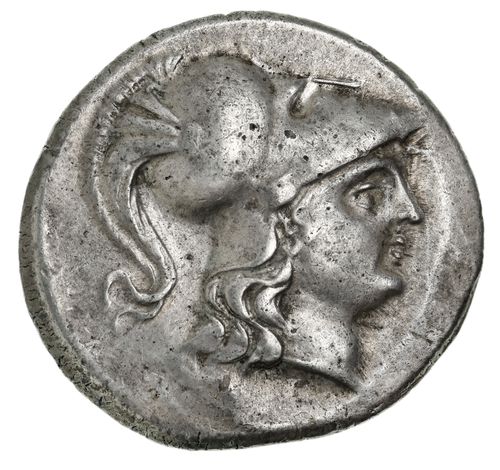
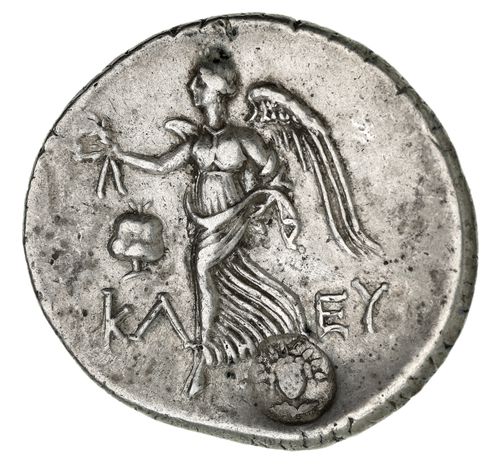
Pamphylia, Side, silver tetradrachm, 2nd - 1st century B.C. (16.66 g), obv. large head of Athena to right, wearing crested Corinthian helmet, rev. Nike advancing to left, wearing long chiton, and peplos wound about waist and left arm, holding in right hand a wreath, pomegranate to left, in field, pomegranate to left, in field, **KLE UC* across field, countermarked with Helios head, (S.5436, SNG Cop.400 (Pl.12), SNG France 3, 695-700, [similar dies, with 676 with similar countermark], cf.BMC 41-46 (p.148-149, Pl.XXVII, 6-7), Greek Coin Hoards in Turkey 547-553 (no cmks), SNG Turkey (Kayhan) 1056 (no Cmk.), SNG Von Aulock 4797 no Cmk)). Extremely fine/nearly extremely fine, rare.
Ex Spink & Son, London, December 20, 1994, in a collector's very descriptive ticket in a flip. ^Side in Pamphylia, founded by colonists from Cumae in Aiolis, advanced to a primary position among the cities of Pamphylia on account of its large and hospitable harbour, which fostered an active ship-building trade. Side was constantly at loggerheads with its neighbor Aspendos, and was as well a prime trophy in the wars of the Hellenistic period. The massive production of tetradrachms of Side, beginning in the second quarter of the 2nd century BC, was a consequence of the Roman defeat of Antiochos III at Magnesia in 190 BC, after which the city was given over to the loyal Roman ally Eumenes II of Pergamon. The city became an anchor for Pergamene and later Roman control of the southern coast of Asia Minor, and the surge of coinage reflects its important position as a centre for ship-building for the Mediterranean fleets and for regional trade. The 'Kleuch-' tetradrachms must have been struck over a number of years, becoming a standard trade coinage. The coinage continued to use the civic symbol of the pomegranate 'sidh'.
- Estimate
- $1,800
- Result Status
- Sold
- Prices Realised
- $1,900