
Lot 426
Sale 142 · Sale 142 Important Coins, Medals & Banknotes
Images
Description
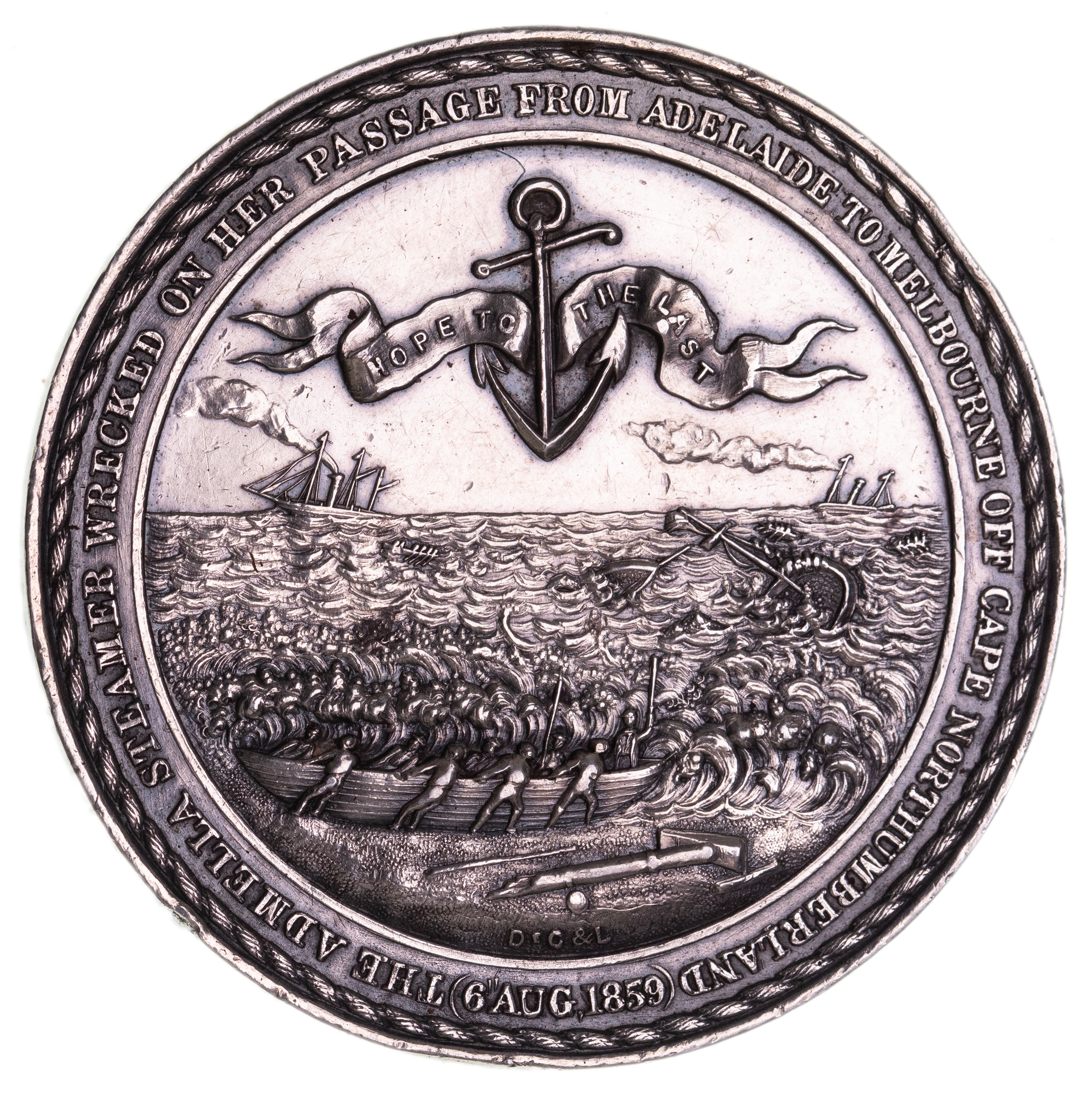
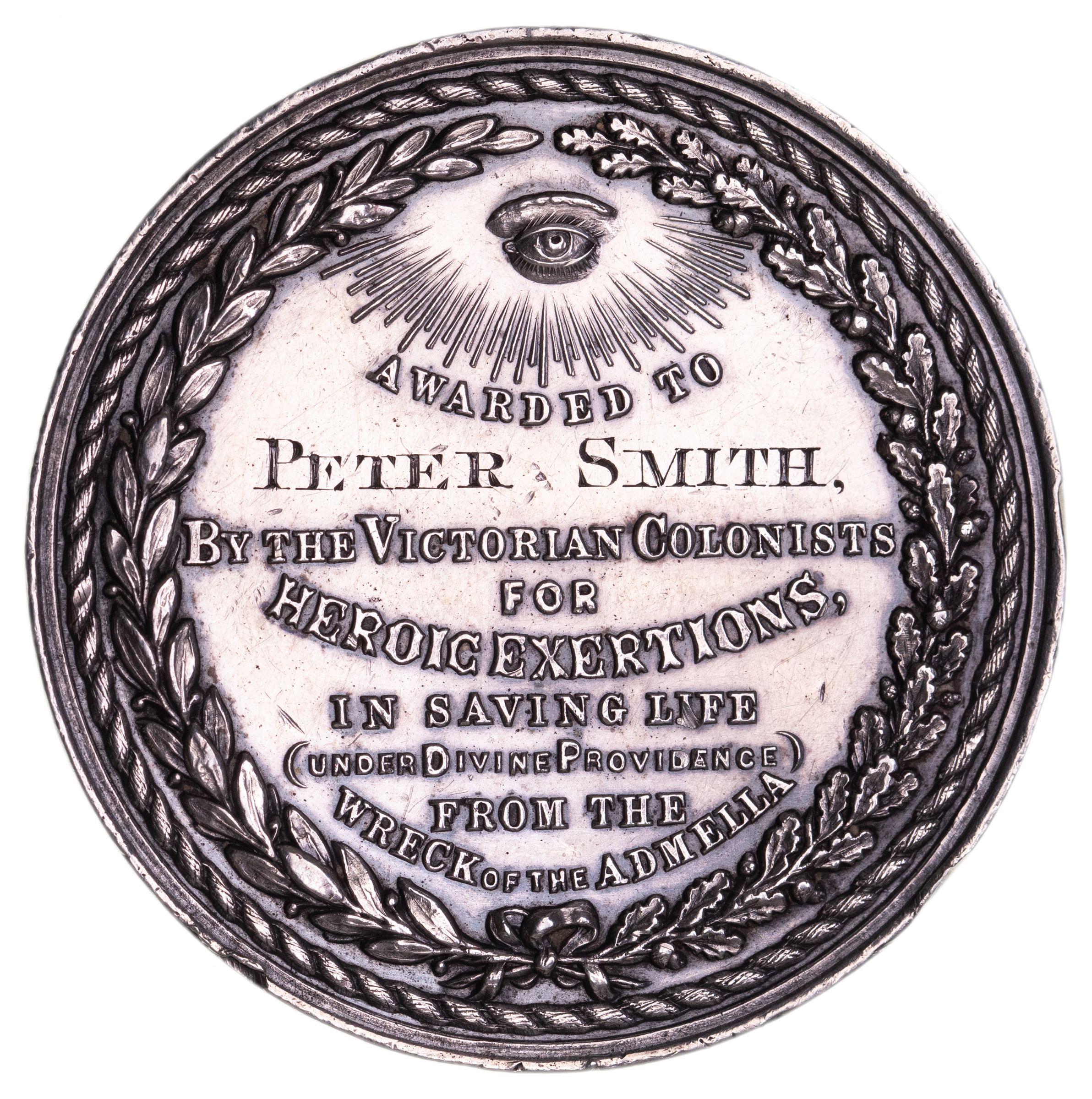
The Wreck Of The Steamship Admella, 1859, in silver (51mm) (C.1859/1), by DeGruchy and Leigh (Sydney), De G & L on truncation to ground, obverse, a scene of the wreck with "Hope To the Last" on a ribbon, divided by an anchor, legend around rim "The Admella Steamer Wrecked On Her Passage From Adelaide To Melbourne Off Cape Northumberland (6 Aug,1859)", reverse, a corded border outside a wreath enclosing, at top of the All-seeing eye, legend in field "Awarded To/ (Peter Smith.)/By the Victorian Colonists/for/Heroic Exertions,/In Saving Life/(under Divine Providence)/From The/Wreck of the Admella".
Ex Spink Auctions, Australia, Sale 32 (lot 1182) and James Spencer Collection.
Together with another unbranded medal case; also a book titled, "Narrative of the Shipwreck Of The "Admella" on the Southern Coast of Australia" by Samuel Mossman, Melbourne 1859, hardcover, 131pp plus contents to viii, with a few photos and invoice for purchase of book from Spink & Son, 53 Martin Place, Sydney. At the front of the book written in pencil are some pieces of information as well as "out of a total of 109 souls 23 only were saved by heroic rescue effort."
Research discloses that this medal was struck at the Sydney Branch of the Royal Mint. The steamship "Admella" of 500 tons was built in Glasgow in 1857. Taking her name from the first syllables of ADelaide, MELbourne and LAunceston, she commenced service between Adelaide and Melbourne in August 1858. The following account is reproduced from the S.A.N.J. July 1950;
"The Steamship," 'Admella", left Port Adelaide on Friday, August 5, 1859, bound for Melbourne carrying 82 passengers and a crew of 31. Included in the cargo were four racehorses which were to take part in the first Melbourne Cup. The story of the tragic loss of the ship is one of epic heroism mixed with almost unbelievable ill-luck which dogged the rescue attempts. Late on Friday afternoon, due to a heavy swell, a mishap occurred to one of the horses, soon after the "Admella" had passed Cape Willoughby and the ship was brought around so that the frightened animal could be quietened. The change in course apparently caused some confusion because of the lack of landmark and the subsequent misreading of the compass. Around about 4.30 on Saturday morning the ship ran onto Carpenter's Rocks, a sunken reef between Robe and Port MacDonnell.
The tragic story from then on is of disappointments and failures in the rescue attempts. It is difficult to believe that, although only a mile from the shore and less than 24 hours steaming distance from Port Adelaide, it was a whole week before the survivors were taken off. By a series of mishaps, the ship's lifeboats were all lost and by Sunday morning more than half of those aboard had been washed off the sloping decks or thrown when the forepart of the ship broke up.
Two of the crew managed to get ashore on a make-shift raft on Sunday afternoon and proceeded on foot to Cape Northumberland lighthouse some twenty-odd miles away. The keeper of the lighthouse, Captain Germein, was later to figure prominently in the rescue attempts. With their numbers diminishing daily and without food or water, the 56 who remained aboard on Sunday morning were to spend five more days of prolonged horror witnessing futile attempts to rescue them. It was not until Saturday, August 13, that the half demented remainder, only 22 including the captain and the sole woman survivor, were taken off. Of the fifteen children and thirty four women aboard, only one woman was saved. By an ironic twist of fate, the four racehorses were rescued and one of them actually took part in the Champion Stakes in October. Adam Lindsay Gordon's poem "From the Wreck" is said to describe his own ride carrying the news of the "Admella". Because of this link a bound volume of the official report on the disaster was added to the Dingler Dell collection of Gordon's relics at Mount Gambier in 1989. Stirred by the tragic loss and the heroism of the rescuers, the Victorian Colonists were instrumental in having a medal struck in London for presentation. This was made at a special gathering in the Exhibition Building in Melbourne on June 25, 1860."
A total of 3 gold and 39 silver medals were awarded. A silver medal recipient was Peter Smith who was a volunteer who was willing to make an attempt to steer the Portland life-boat between the rocks although the crew of the life-boat were unwilling to make the attempted passage to the shipwreck. After his willingness the crew of the life-boat changed their mind and proceeded with the rescue attempt. Unfortunately the attempted rescue had to be abandoned. Peter Smith was a seaman employed on shore in the neighborhood as an oarsman. In the damaged life-boat of the "Admella" picked up on the beach, and in which he along with his gallant mates, rowed through a fearful surf several times towards the wreck, which they were first to reach on the day of the rescue, when they saved three of the sufferers.
- Estimate
- $8,000
- Result Status
- Not offered