
Lot 2016
Sale NZ1 · The Unique & Unparalleled Collection of New Zealand Historical Medals & Memorabilia (Part 1)
Images
Description
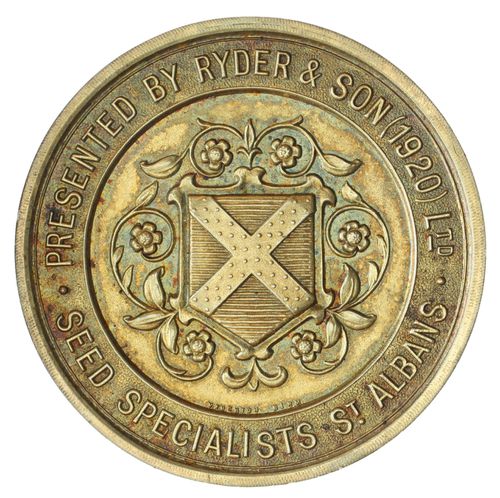
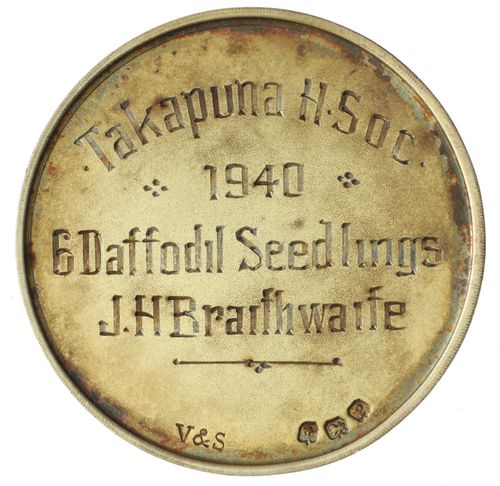
Ryder Medal, uniface, struck in silver gilt (38mm), by V&S (Vaughton & Son, Birmingham), hallmark for Birmingham 1939, reverse inscribed 'Takapuna H.Soc./1940/6 Daffodil Seedlings/J.H.Braithwaite' [illustrated]; The Royal Horticultural Society, Banksian Medal, struck in copper (38mm), no maker, reverse inscribed 'To/Mr J.H.Braithwaite/2nd Prize For/6 Seedling Narcissi/Raised by Exhibitor/Auckland Spring Show/1925'. Extremely fine, the first in a Vaughton's Ltd fitted case, the second with carbon spots on obverse. (2)
(Courtesy Wikipedia - The Free Encylopedia):
Samuel Ryder (24 March 1858 - 2 January 1936) was an English businessman, entrepreneur, golf enthusiast, and golf promoter. He originated the idea of selling garden seeds in "penny packets" and built a very successful business on the concept.
At the age of 50 he became an enthusiastic golfer and then from 1923 to 1925 he, together with his brother James, started sponsoring a number of golf tournaments and matches mostly at his home club of Verulam near St. Albans. From late 1925 he started employing Abe Mitchell as his private coach. In early 1926 the idea for a match between British and American professional golfers was proposed. Ryder became involved and sponsored the event. It had been his intention that the match would be the first Ryder Cup but it was later decided that the match would not be an official contest. The first official event did not take place until 1927 for which Ryder donated a gold trophy.
In the 1890s, Samuel Ryder started to sell packets of seeds through the post, priced at one penny each. Other seed merchants also made postal sales, but their packets were much more expensive. He started selling from his home in St Albans, which had good mainline railway connections. He kept his stock in the garden shed of his terraced house on Folly Lane, and was assisted by his wife and daughter. The packets would be posted each Friday so that his customers, working men, would receive them for their time off on Saturday afternoons. The business grew rapidly and Ryder became wealthy. Eventually, the business moved to a large packaging workshop on Holywell Hill, employing around 100 staff. The art deco seed hall is now a Caf? Rouge restaurant. He established a separate herb business, Heath and Heather, with his brother James in 1922 and in 1924, the company moved to a former hat factory, which had a floor area of some 24,000 square feet (2,200 m2).
- Estimate
- $400
- Result Status
- Passed in