
Lot 2990
Sale 137 · Important Australian, British, World, and Ancient Coins, Banknotes, and Medals
Images
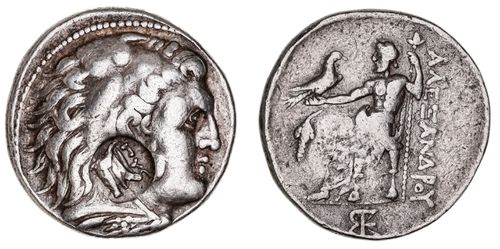
Description
Thrace, Byzantion, (c.235-220 B.C.), silver tetradrachm, (16.85 g), originally struck c. 280-275, probably at Pella Mint, under Antigonos II Gonatas, subsequently countermarked for use in Byzantion, obv. head of Herakles to right, wearing lion's skin headdress, below his ear, countermarked in a large, circular indent, **PY* above a galley prow to right, with a dolphin swimming downwards on the truncation of the prow, rev. to right **ALEXANDROU*, Zeus seated left on backless throne, holding eagle on his outstretched right hand and long scepter in his left, in field to left, bunch of grapes, in exergue, monogram of **SKE*, (for the original coin, cf.S.6713, Mathisen 26, Price 590, for the countermark, see: M. Thompson, "A Countermarked Hoard from Buyukcekmece", MN VI (1954), type II, 48-52, and W. M. Stancomb, "Some Countermarked and Overstruck Hellenistic Coins from the Region of the Thracian Bosporus", NC 167 (2007), p. 27, 6. Toned, host coin lightly toned, very fine, countermark nearly extremely fine, an extremely interesting and unusual coin, illustrating a particular event within Byzantion's economic history.
Ex D.G.L.Worland Collection. Previously Nomos 22, lot 70. With ticket.
It appears that this countermark was placed on Attic weight silver coins in order to allow them to continue circulating in Byzantion after the city had switched to a lighter, Ptolemaic, standard for its coinage. This, in turn, was caused by the tribute the city was forced to pay to the Galatians in Thrace, resulting in an ever increasing shortage of silver. (per Nomos).
- Estimate
- $1,500
- Result Status
- Sold
- Prices Realised
- $900