
Lot 2937
Sale 136 · Important Australian, British, World, and Ancient Coins, Banknotes, and Medals
Images
Description
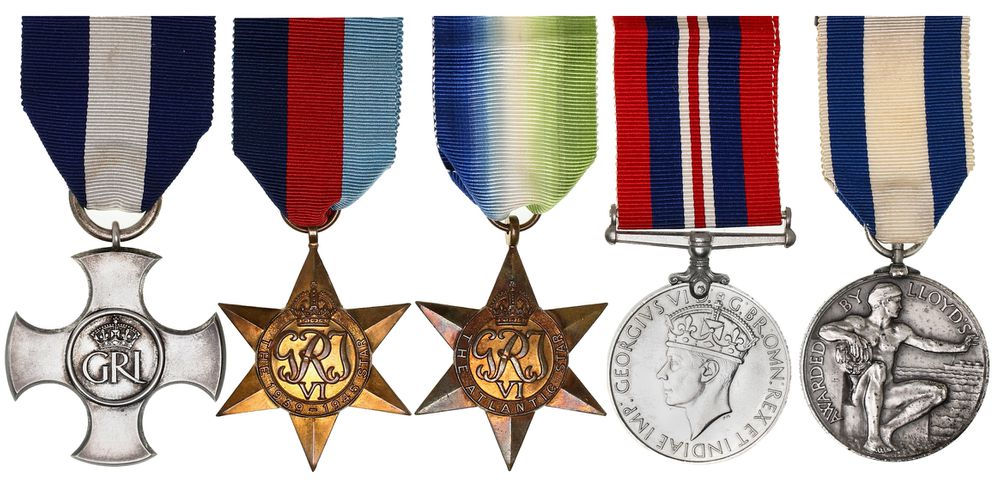
DSC and Lloyd's Bravery Medal to KIA: Distinguished Service Cross (GRI [GVIR]), with pin-back suspender; 1939-45 Star; Atlantic Star; War Medal 1939-45; Lloyd's War Medal for Bravery at Sea, with pin-back suspender. Chief Engr A.H.Hughes. July, 1942 on first medal, the second to fourth medals unnamed as issued, Chief Engineer Officer A.H.Hughes, M.V. "Empire Tide." 4th July 1942. on last medal. Both named medals engraved. The first and last medals in cases of issue, some toning, otherwise uncirculated.
Together with various photos, documents and letters including an In Memoriam, Albert H. Hughes program for the Memorial Service and Dedication of Memorials, 11 November 1947, also the box for delivery of the war medals sent to Mrs E.V.Hughes at Cheshire. ^DSC: Supplement to LG 22/12/1942, p5568 - to Mr. Albert Henry Hughes, Chief Engineer Officer.^'For fortitude, seamanship and endurance in taking merchantmen to North Russia through heavy seas and in the face of relentless attacks by enemy aircraft.'^Albert Hughes was presented with the DSC at an Investiture at Buckingham Palace on 9 March 1943.^Lloyd's War Medal for Bravery at Sea: Lloyd's List & Shipping Gazette 3/2/1944, the joint citation states as follows.^'The vessel was attacked by enemy aircraft almost continuously for five days and nights while proceeding to a North Russian port. Two of the enemy were destroyed. After the attack ceased, enemy submarines were sighted and a nearby vessel was torpedoed. By taking evasive action and increasing speed to the utmost, Captain Hervey was able to get away from the enemy. Throughout the whole period of the attacks Chief Engineer Hughes and Second Engineer Griffiths remained in the engine-room, and by their efforts ensured the utmost possible speed under conditions of great stress. Although almost overcome by lack of sleep they carried on with the pumping out of water ballast and the handling of the main engines until the vessel was refloated. It was mainly due to the inspiring leadership and courage of the Master and the magnificent conduct of the two engineer officers that the ship was brought to port. Chief Steward Carswell behaved with outstanding courage in the face of great danger when a gunner was wounded during the action with enemy aircraft. He made his way to the gun position and carried the gunner down to the ship's hospital. There he inserted sixteen stitches in the man's leg while the attack on the vessel proceeded. But for the prompt action and skill of Mr. Carswell, the wounded man might have lost his life.'^Chief Engineer Officer Albert Henry Hughes, aged 46, was later killed-in-action while serving on S.S.Nebraska which was torpedoed by the submarine U-843 off Ascension Island on 8 April 1944. He was one of two men killed in the explosion caused by the initial torpedo strike and two further attacks by the U-Boat resulted in the sinking of the Nebraska. He is commemorated on the Tower Hill Memorial in London.^With research.
- Estimate
- $8,000
- Result Status
- Passed in