
Lot 3687
Sale 133 · Important Australian, British, World, and Ancient Coins, Banknotes, and Medals
Images
Description
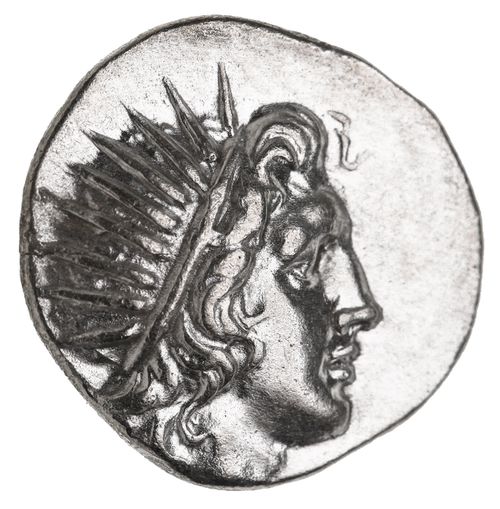
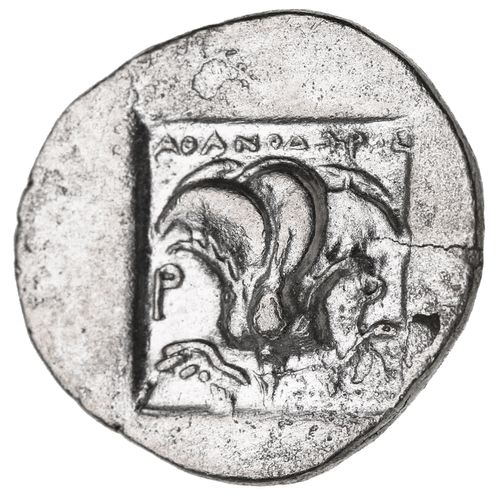
Caria, Rhodes, (190-170 B.C.), silver drachm, (2.87 g), obv. Head of Helios radiate right hair in locks, rev. Inside shallow incuse square a Rose with buds, to left P and right O, above **AQANADWROS*, to left a lyre, to right a bud, (S. 5063 variety, BMC 241, Jenkins Group B, No.36 [dated to 170-150 B.C.], HGC 6, 1458 [S]). Bright, extremely fine and rare.
Ex Classical Numismatic Group, bought January 29, 2008, with descriptive ticket within a flip.
This late series of silver fractions was among the longest-running of all the Rhodian series. Its types continued from that found on previous issues. Helios was adopted as the patron deity of Rhodes upon the city's foundation in 407/7 BC, and became the nearly universal obverse type of Rhodian coinage over the following four centuries. The rose was a pun on the city's name, a common practice in Greek coinage, and also was the dominant type on the reverse of Rhodian coins until the first century AD. The plinthophoric series runs from circa 190 (188) BC to 84 BC, and represents a complete overhaul of the monetary system, in which the traditional Rhodian standard was abandoned in favor of a new standard based on a 'plinthophoric' drachm of around 3 grams, which was more commensurate with other currencies of the time. Another innovation was the abandonment of all denominations higher than a drachm, and a proliferation of regular issues of hemidrachms and diobols. As mentioned above, the types remained the same, but certain details were altered. On drachms and diobols Helios was now more often portrayed in profile, rather than facing, and the facing portraits on hemidrachms were now radiate. The reverse design was placed into a shallow incuse square, which is where the name of the series is derived (plinthos = brick or ingot). The exact reason for this major reorganization of Rhodian coinage is not known for certain, but the prevalent theory is that it was undertaken to conform to the changes extant under the terms of the Peace of Apameia in 188 BC. Whatever the reason, this change was enduring, with the series lasting nearly 100 years. The plinthophoric coinage came to an end during the First Mithridatic War, during which the Roman survivors of the Vespers of 88 BC fled to Rhodes, which was subsequently besieged by the Pontic king. The siege lasted for six months, during which time the silver supply had dwindled to such low quantities that the coinage was supplanted by issues of large-denomination bronzes (see Ashton, Coinage, pp. 61-5).
- Estimate
- $400
- Result Status
- Sold
- Prices Realised
- $400