
Lot 4190
Sale 130 · Important Australian, British, World, and Ancient Coins, Banknotes, and Medals
Images
Description
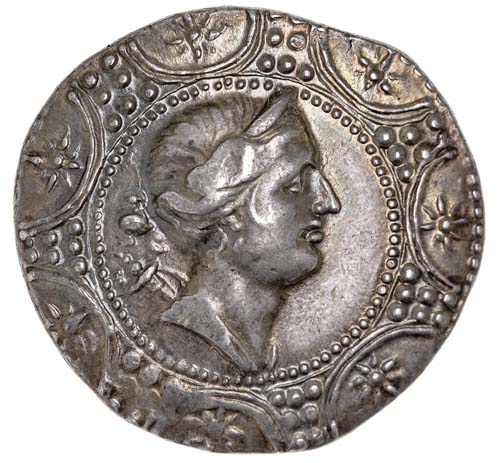
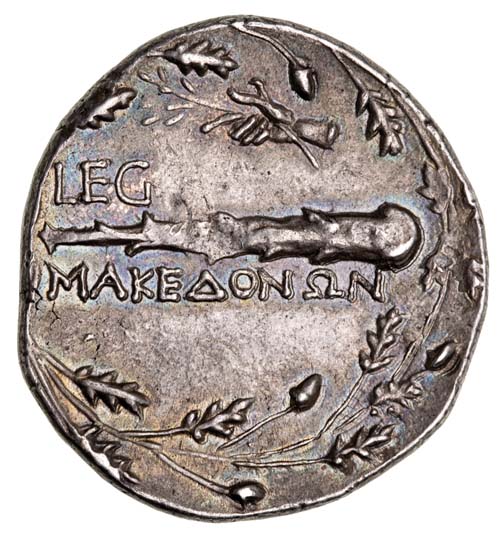
Macedon (Roman Protectorate), Republican period, Roman embassy, (c.148-147 B.C.), silver tetradrachm, (16.73 g), Amphipolis or Thessalonika mint, obv. diademed and draped bust of Artemis right, bow and quiver over shoulder, in boss of a Macedonian shield, rev. club, above, LEG and hand holding olive branch to left, below, MAKE**D ONEWN*, all within oak wreath, [thunderbolt] to outer left, (S.1388, MacKay, Macedonian, Series 1 [Obv.1; Rev. 1]; AMNG III, 189; HGC 3, 1105; SNG Cop. 1317 [same dies], SNG Lockett 1540 [same dies], SNG Ash. 3310 [same dies]. Attractive deep cabinet iridescent patination, extremely fine and very rare, a pleasing example of this rare type.
Ex Triton XIII, January 5-6, 2010 (lot 116) with ticket.
A recent similar example in a sale by Gorny & Mosch, Auction 284, 7 March 2022 (lot 236) realised a hammer of 6000 Euros.
The CNG footnote on this lot is noted below.
This type was probably issued immediately following the suppression of Philip VI Andriskos' revolt. As the Romans did not think the Macedonian people had supported Andriskos, they sent a peace embassy, instead of an army of occupation, after his defeat. The Latin legend LEG refers to 'legatio, an embassy, and the hand holding the olive branch an offer of peace.
Gorny & Mosch comment on the issue as follows :These rare coins are believed to date from the time of the 4th Macedonian War. After the end of Perseus, Macedonia was divided into four independent republics, which apparently did not enjoy great popularity among the population. The Roman army had withdrawn after the war and so a pretender to the throne named Andriskos, who probably came from Adramyttion, had an easy time of it, especially since the Romans persistently underestimated the danger that emanated from this man. Only when all of Macedonia and parts of Thessaly had fallen into his hands did Rome send a legion under the command of the praetor Publius Juventius Thalna, who, however, went down with flying colors. Thereupon Rome sent Quintus Caecilius Metellus with two other legions, who, with the support of Attalos of Pergamum, defeated Andriscus. However, it is unclear how the tetradrachms of the present type are to be classified in these events, because the legate, who apparently gained control of the silver mines of Amphipolis, remains anonymous on these coins.
A.M. Burnett published a hoard ("Aesillas: Two new hoards," CH VII) containing a small number of these tetradrachms along with various Athenian new style tetradrachms, Thasos tetradrachms, and Aesillas tetradrachms. Due to the light wear on these LEG/ MAKEDONON tetradrachms, Burnett concluded that they were struck shortly before Aesillas' issues, a downdating of approximately fifty years. Some numismatists have adopted this proposal (see Crawford, CMRR, p. 197). It seems more likely, however, that any apparent anomaly in degree of wear can be explained by the possibility that the hoard was assembled over a period of time, a supposition also supported by the other coinage found in the hoard. For example, the Athenian issues span the years 159/8-137/6 BC, and a number of these are also as well preserved as the Macedonian coins. The evidence of this single find is thus inconclusive, and should not override MacKay's analysis without further confirmation.
- Estimate
- $6,000
- Result Status
- Sold
- Prices Realised
- $4,800