
Lot 4624
Sale 107 · Important Australian & World Coins, Tokens, Medals & Banknotes
Images
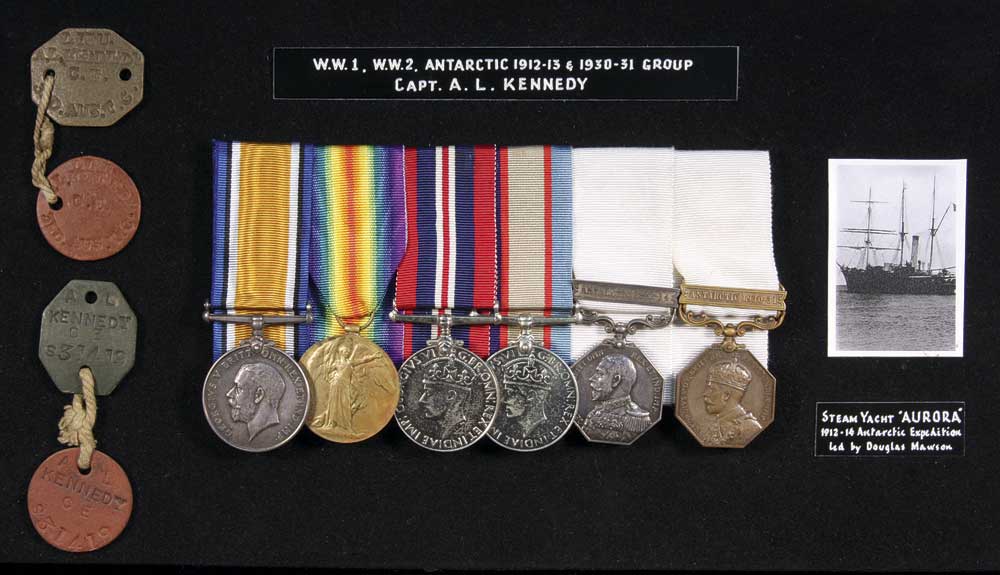
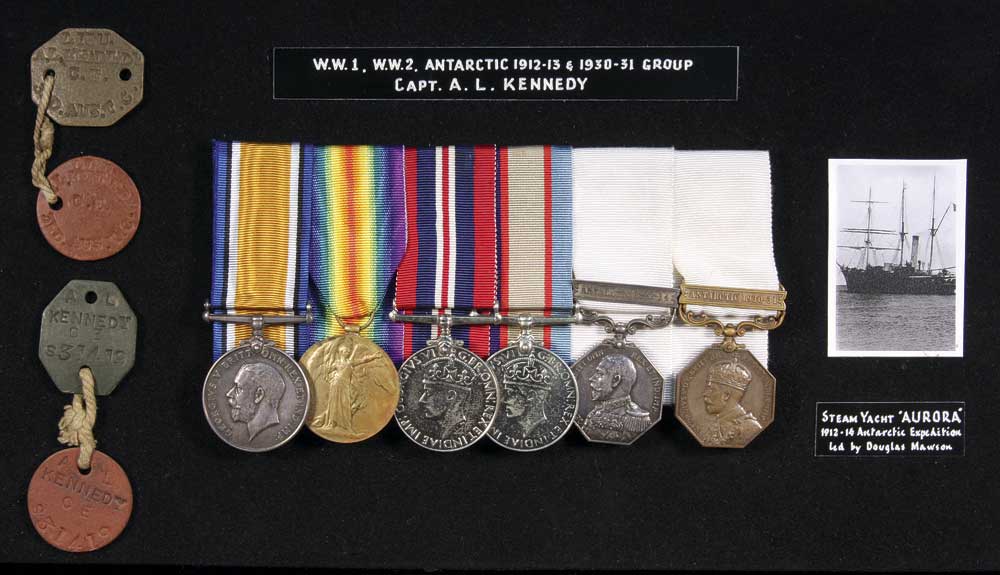
Description
Group of Six to Antarctic expeditioner: British War Medal 1914-18; Victory Medal 1914-19; War Medal 1939-45; Australia Service Medal 1939-45; Polar Medal in silver (GVR in Admiral's uniform), clasp - Antarctic 1912-14; Polar Medal in bronze (GVR crowned bust), - clasp - Antarctic 1930-31. Lieut. A.L.Kennedy. A.I.F. on first two medals. S31419 A.L.Kennedy on second and third medals, A.L.Kennedy Aurora on fifth medal and Alexander L.Kennedy on last medal. First five medals impressed, last medal engraved. Display court mounted, very fine - extremely fine.
Together with two sets of fibre dog tags, one for Lieu. A.L.Kennedy/3rd Aus.T.C. the other for A L Kennedy S31419.
Antarctic Silver Medal 1912-14: PRO ADM 1/8407.
Antarctic Bronze Medal 1930-31: LG 1/5/1934.
Alexander Lorimer Kennedy, draughtsman and surveyor with South Australian Railways, age 26, born at Woodside, South Australia; two years with militia Adelaide University Rifle Club; WWI: Enl.30Aug1915; commissioned 27Nov1915; Emb.20Feb1916; 3 Tunn Coy, Aust Mining Corps; WIA 01Jul1916 France; RTA 04Jun1919; commission terminated 19Jul1919. WWII: Enl.28Jul1941 at Keswick, South Australia; Disch.23Oct1942 as Lieutenant ex Recovery Station AAOC.
After attending St Peter's College in Adelaide Alexander Kennedy studied at Adelaide University and while still a student there he was selected by Douglas Mawson, who had been a lecturer at Adelaide University, to join his AAE (Australian Antarctic Expedition) on the SY Aurora. He received special tuition to enable him to serve as magnetician at the Western Base (Queen Mary's Land). He participated in several sledging excursions and accompanied John Wild, Leader of the Queen Mary Land wintering station, as cartographer for his main eastern journey.
Cape Kennedy, a point on the east side of Melba Peninsula, approximately 6.5 kilometres south west of David Island is named in his honour after it was discovered by the Western Base Party of the AAE, 1911-l4.
In 1914 Kennedy was appointed as Magnetic Observer for the Carnegie Institute in Washington, USA and then in 1915 completed a Bachelor of Engineering degree at the University of Adelaide. He served with the AIF (Mining Corps, 3 Tunnelling Coy) in World War I, from 1916 to 1918. Alexander also held a Diploma in Mining and a Fellowship of South Australian School of Mines.
From 1921 Kennedy was Chief Assistant at Adelaide Observatory and in 1924 he was Assistant at Mt Stromlo Observatory, Australian Capital Territory. He returned to the Antarctic in 1930 serving as magnetician on BANZARE (British Australian New Zealand Antarctic Research Expedition) led by the now knighted Sir Douglas Mawson in Discovery's second voyage. From 1928 he worked as a mining engineer in Western Australia. He also served with the Australian Army during WWII. Alexander Kennedy died in 1972.
- Estimate
- $10,000
- Result Status
- Sold
- Prices Realised
- $23,000