
Lot 3312
Sale 90 · Important Australian & World Coins, Medals & Banknotes
Images
Description
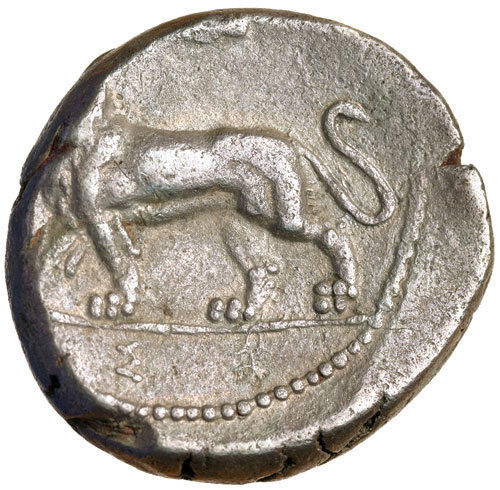
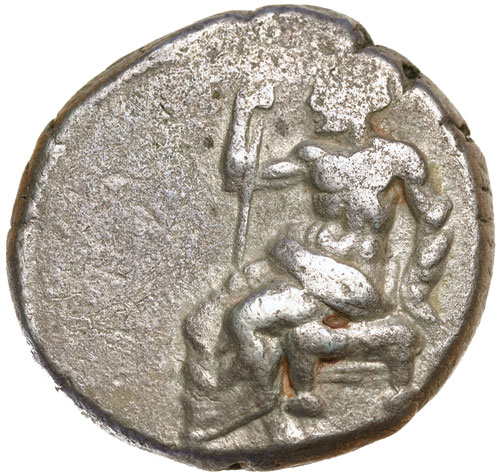
Persia, Alexandrine Empire in Persia. (circa 322-312 B.C.), silver tetradrachm or double shekel (23mm, 16.246 grams), Babylon mint, obv. Baal seated left, holding sceptre, rev. spear-head to left above, with lion walking left on ground line, **S* in exergue. (cf.S.6140, Nicolet-Pierre pages ; cf.MIG type 7b; Babelon, Perses -; cf.BMC Arabia 4-5 [Pl.XX 17, XXI 1); Trait? -; SNG Copenhagen -). Nice very fine with partial flat strike and off centred reverse, type unpublished with this combination.
Ex LHS Numismatik AG, Zurich. Completingg his expeditions to the outer limits of Asia Minor, Alexander the Great led his army westward late in 331 BC. The metropolis of Babylon was surrendered by its satrap, Mazaios, whom Alexander rewarded with the local governorship. Alexander made Babylon his royal seat, and there established one of his most important mints, from which a large quantity of regular `Alexandrine' or 'imperial' coinages were struck, including the impressive dekadrachms of circa 327/6 BC. In addition to the `imperial' coinages, Babylon also produced a substantial group of local coinages, some of which initially bore the name of Mazaeus. But after Mazaeus death in 328 B.C. the issue of silver `lion staters' continued in at least three smaller denominations, all with a seated Baal on the obverse and a standing lion on the reverse. The staters initially were struck to the weight of the Attic tetradrachm, but eventually were reduced to the lighter Persic standard of the Babylonian shekel. Though initiated under Mazaios, both the gold and the silver coinages were produced for decades afterwards, with the final silver coins probably being struck circa 288/7 BC under Seleukos I.
- Estimate
- $600
- Result Status
- Sold
- Prices Realised
- $0