
Lot 3067
Sale 85 · Important Australian & World Coins, Medals & Banknotes
Images
Description
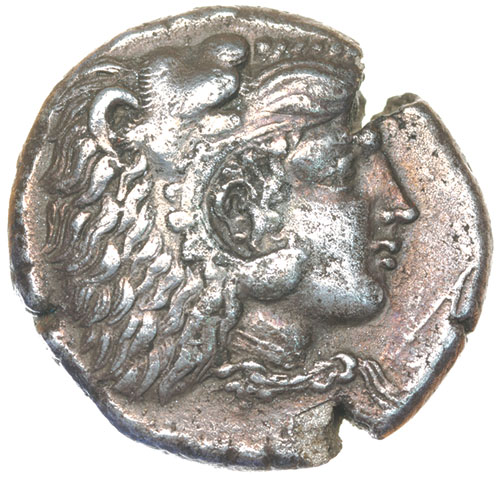
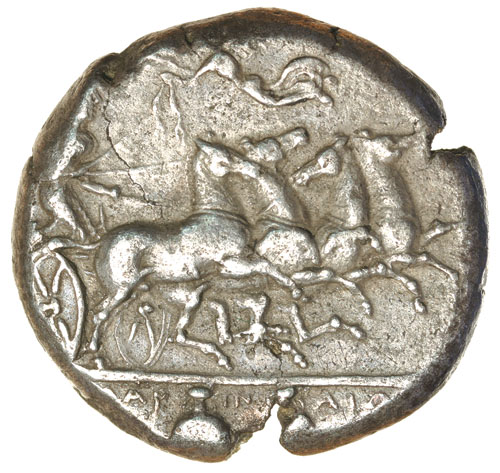
Sicily, Camarina, silver tetradrachm, c.410 B.C., (16.73 grams), (p.79, £1800), Obv. Fast quadriga driven right by Athena, Nike flying left to crown her, in exergue two amphorae and **[KAM]AR IN AIW[N]*, Rev. Head of young Herakles to right, in lion skin headress, to right a bow, (cf.S.759 [p.79, £1800], Westermak & Jenkins 15.1 [This Coin, Obv.11, Rev. 20], SNG Lloyd 870 [same obverse die], Ward Colln. [Greek Coins & Their Parent Cities, 1902, 170] and Sotheby Sale 4.4.1973 (lot 122 same dies) = Hunt Sale I Sotheby, New York, 19 June 1990 [lot 79, realised $44,000], SNG ANS 1207 same reverse die). Flan splits in edge from coin striking, otherwise very fine and very rare, being one of only three known.
Ex Morton & Eden Ltd. Sale, London, 23-24 November 2004 (lot 528), previously from Galerie de Monnaie, Los Angelos Sale June 9, 1978 (lot 1355) and Myers Auction Sale 12, 4th December 1975 (lot 76, realised US$1000), and Hesperia Art Bulletin No.32 item 102 (listed at $400). The Hunt Sale in New York No.1, on June 19, 1990 (lot 79, realised $44,000) came fom the same dies. Westermark & Jenkins "The Coinage of Kamarina" p.195 described this coin as No.153.1. This coin was issued as a celebration of Camarina's support of Syracuse against the Athenian Expedition. The coinage of Camarina, like that of Agrigentum underwent a transformation at the end of the fifth century. As with Agrigentum, the new and brilliant phase of Camarina's coinage owes much to the coinage of Syracuse and the outstanding coin artists of contemporary Sicily, such as Exakestidas whose signature appears on several dies of Camarina. The obverse of the tetradrachm is based on Syracusan prototypes and the only difference is that the Syracusan charioteer is replaced by Athena. The die of this rare variety is additionally very close to that of Catana. The appearance of Athena as the charioteer follows from her position as patron deity of Camarina, while the choice of a Syracusan prototype may reflect Camarina's support of Syracuse during the period, in particular the substantial help she gave to the Syracusans in their victorious campaign against the Athenian invasion and siege of Syracuse in 415-413 B.C. The reverse depicts a beardless head of Herakles wearing a lion skin, an allusion to his defeat of the Nemean lion. The appearance of Herakles on coins of Camarina is somewhat puzzling as there is no literary or archaeological evidence for his cult at the city. The prominence accorded to him on the coinage, however, leaves no doubt that he must have been an important cult figure there.
- Estimate
- $5,000
- Result Status
- Sold
- Prices Realised
- $0