
Lot 3386
Sale 79 · Important Australian & World Coins, Tokens, Medals & Banknotes
Images
Description
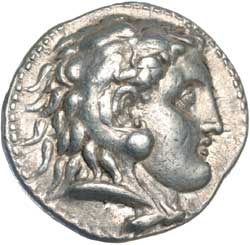
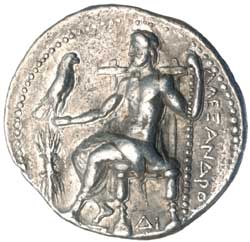
Macedon, Kingdom of, Alexander III, (336-323 B.C.), silver tetradrachm, (17.136 grams), Memphis mint, issued c.323-316 B.C., obv. head of Herakles to right wearing lion skin, dotted border, rev. Zeus seated on throne to left, eagle in outstretched hand, thunderbolt to left, **ALEXANDRO[U]* to right, **DI* under throne, dotted border, (cf.S.6713, Price 3977, BMC 3977, M.-, Zervos 'Ptolemy' IX]). Nearly extremely fine, rare.
An important Egyptian issue of Alexander the Great. In December 332, the Macedonian army and navy reached Pelusium (modern Port Said). Here, Alexander was met by the Persian satrap Mazaces and an official named Amminapes, who surrendered the country. Mazaces may have wanted to behave a more heroically. However his troops had been destroyed in the battle near Issus- and knew that in the event of war, he would have to face both the invader and the native population, which had revolted very recently (in 338-336). Amminapes may have had an agenda of his own for he had lived in Macedonia and knew the conqueror. He was to be rewarded two years later. The future government of Egypt was to be divided among several persons. An Egyptian and an Iranian, Petesis and Doloaspis, were to lead the civil administration. At least eight military commanders had to serve under two Macedonian officers named Balacrus and Peucestas. A third officer was appointed as admiral, Polemon. Alexander left a garrison at Pelusium, ordered his navy to occupy the Egyptian capital Memphis and led his army to Heliopolis (north of modern Cairo). This was one of the most important places in Egypt's religious life: here was the temple of Ra, the sun god who protected the pharaoh. It was perhaps in this city that Alexander accepted the titles of the Egyptian ruler. From now on, the priests wrote about him as the Horus, the protector of Egypt; king of Upper and Lower Egypt; beloved by Amun; the chosen one of Ra; the son of Ra, Alexander. There is no reliable evidence for a coronation ceremony. The new pharaoh continued to Memphis, where he sacrificed to the Apis, a manifestation of the Egyptian god Ptah. Although our sources do not mention it, we can be confident that he paid a visit to the pyramids at Giza. Everywhere the Macedonians were greeted as liberators. The Persians had occupied Egypt from 525 to 404 and had reconquered their former possession in 343, only eleven years before. The Egyptians still remembered their former freedom, an idea that Alexander knew how to use for his own benefit.
- Estimate
- $1,300
- Result Status
- Sold
- Prices Realised
- $1,050