
Lot 4991
Sale 78 · Important Australian & World Coins & Banknotes, The Lampard Collection, The James Atkinson Collection
Images
Description
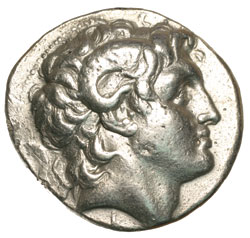
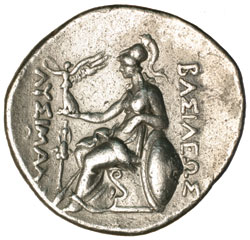
Thrace, Kingdom of, Lysimachus, (323-281 B.C.), silver tetradrachm, (16.464 grams), Pergamon mint, style of that issued c.287 B.C., obv. head of Alexander to right, with diadem and horn of Ammon, within dotted border, K under bust, rev. Athena enthroned to left, supporting Nike, to inner left a cult statue, to far left crescent, in exergue a **WX* monogram, to right **BASILEWS to left **LUSIMAXOU*, (cf.S.6814, Thompson 220 [illustrated Plate 21 [same dies], Arnold-Biuchi 36 [dies of obv.8, rev.35, dies illustrated as 34a, Pl.3 [error on plates], SNG Fitz. 1850 [same dies]). Well centred and with a very high relief, minor wear on the horn, with a fine eye, good very fine and very rare, the die combination known by one museum example (Cambridge).
The Pergamon mint issues of Lysimachus are considered to have numismatically the finest of the artistic representations of portraiture of Alexander the Great. The issue signed by the engraver K are considered the best of the dramatic style and the closest to the Copenhagen head of Alexander, which Herbert A. Cahn attributes to his second creative die-cutter 'Modellmeister B', c.287 B.C. It was at 'the mint in Pergamon while Philetairos was serving Lysimachus there from c.287 B.C. to c.282 B.C. the Alexander heads were done in a local version of this later style which is distinctive and very beautiful (fig. 3a)' Blanche R. Brown 'Royal Portraits in Sculpture and Coins' p.14); (fig 3a is the best K tetradrachm in the ANS collection which is in similar condition to this specimen). 'In them the surface richness remains but the modelling is more sensitive and subtle. The basic form is relatively more plastic and unified, with fewer concave transitions and with convex forms more clearly delimited and structured...the drawing itself is suave and refined. The Pergamene Alexander ... still has a pervading sense of movement and life. Its particular refinements of features and outlines are not echoed in the Copenhagen portrait, but the smoother, more simplified transitions of the modelling of the face are comparable.' (Ibid, p.14-15).
- Estimate
- $2,000
- Result Status
- Sold
- Prices Realised
- $1,600