
Lot 3266
Sale 72 · Important Australian, British & World Coins, Medals & Banknotes
Images
Description
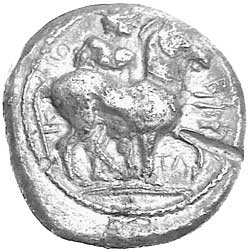
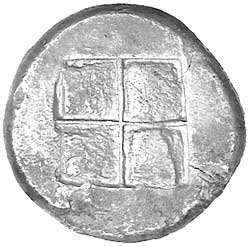
Thraco-Macedonian, The Bisalti tribe, (c.470 B.C.), silver octodrachm, (27.93 grams), obv. BIS A **LT IK O, around nude warrior (or herdsman) wearing petasus, standing to right next to his bridled horse and carrying two parallel spears, winged eagle flying to right and with two exergual line, rev. quadripartite incuse square, (S.1318, cf.Raymond [NN&M 126] Pl.II, 1-2; SNG Ash. 2242, Sv. 16, Pl.XI, 1-6, BMC 2 [p.140]). Test cut on obverse, a new obverse die, previously not noted, otherwise good very fine and extremely rare.
This impressive coin of the Bisalti shows a young man leading a horse wearing a traditional northern hat which is like a petasus worn by the Macedonians and Thessalians. In addition he carries two spears. He has been identified as Rhesus or Ares, but it is uncertain if he actually represents a true mythical figure. Thrace was in the late sixth century part of the Persian Empire and the Bisalti were a strong and somewhat independent force, as they refused to assist the Great King of Persia when his army crossed Thrace to invade mainland Greece in 480 B.C. Later the Bisalti lost their power, probably to Alexander I of Macedon, the new power in the region after the Persian defeat (who also struck octodrachms which are very similar to the issues of the Bisalti). These heavy coins of the Bisalti have been found in hoards from Egypt and other parts of the Persian Empire. They were not part of the famous Asyut hoard of Egypt which was buried about 475 B.C. and its absence does suggest a somewhat later date for this octodrachm of the Bisalti. It has been suggested that the Bisalti won control of the silver mines around Lake Prasias and that their coinage was terminated around the time of the foundation of the Athenian colony at Ennea Hodoi and the subsequent disaster at Drabescus in 465-4 B.C. This battle, in which the Athenian colonists were exterminated by the native Thracians, may have enabled Alexander I of Macedon to take possession of the mines for himself. Several examples in recent years have sold in the international auction market for about $25000. This example compares with these pieces, it comes from a obverse die with an eagle to right symbol and different letter placement.
- Estimate
- $9,000
- Result Status
- Sold
- Prices Realised
- $9,000